


Google core updates don’t just “change rankings", they reset how visibility works in search. One update can push your top pages down, lift competitors above you, and completely shift where your traffic comes from.
That’s why reacting blindly no longer works. If you care about consistent, long-term SEO growth, you need to understand what actually changes during a core update and why Google reorders results the way it does.
In this guide, we’ll break it down step by step based on how people really search and think:
- What is a Google core update
- Why did rankings drop after the Google update
- How to recover from the Google core update
- Google ranking factors 2026
- SEO impact of algorithm updates
By the end, you’ll have a clear, practical framework for analyzing ranking drops, adapting your content strategy, and staying competitive after every update.
What Is a Google Core Update?
A Google core update is a broad change in how Google evaluates and ranks content in search results. It’s not about fixing one issue, it's about improving how results are ordered overall. Unlike targeted updates (like spam or product reviews), core updates look at the bigger picture. They reassess how Google measures things like content quality, relevance to the query, and overall trustworthiness across the web.
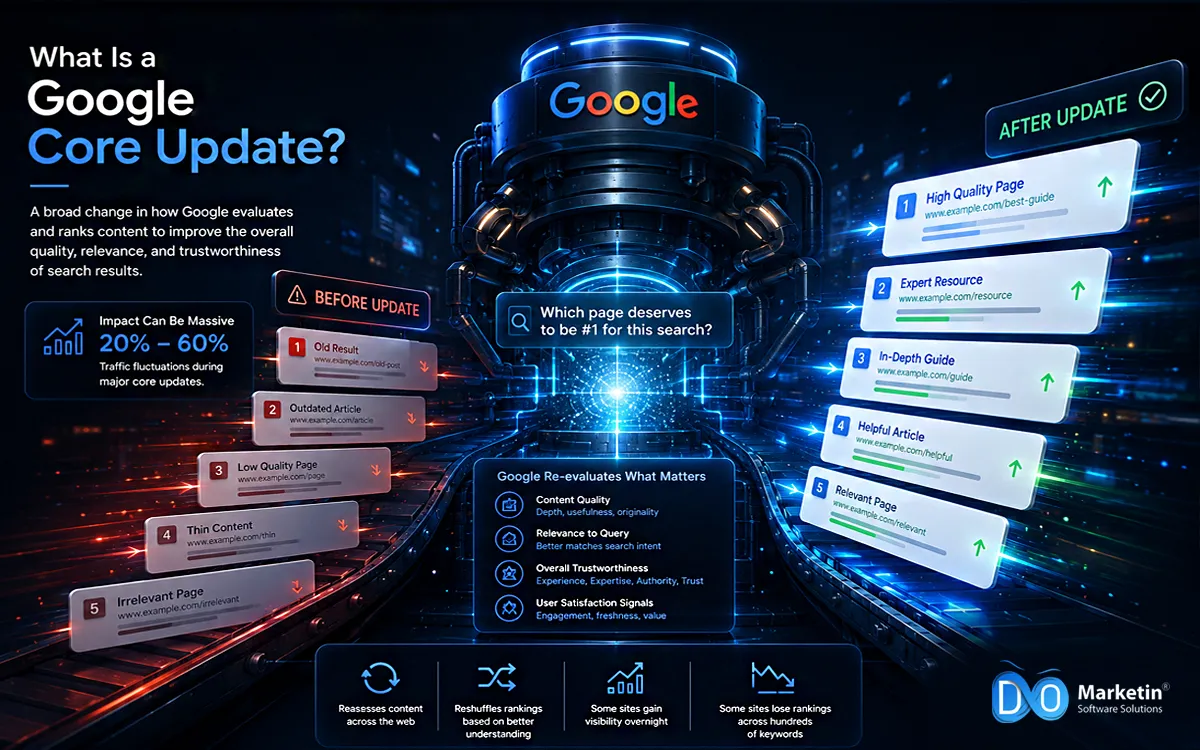
Google releases several core updates every year, and their impact can be massive. According to multiple SEO industry studies, websites can experience traffic fluctuations of 20% to 60% during major updates depending on how well their content aligns with Google’s evolving quality standards. Some sites gain visibility overnight, while others lose rankings across hundreds of keywords.
At its core, Google is always trying to get better at answering one question: which page actually deserves to be #1 for this search? A core update simply reshuffles the results based on a better understanding of that.
How Do Google Core Updates Affect Rankings?
Google core updates can influence rankings in several ways, from changing search intent interpretation to re-evaluating content quality and authority signals. These updates don’t target a single website or industry. Instead, they reshape how Google determines which pages deserve higher visibility in search results. Understanding these ranking shifts helps businesses adapt their SEO strategies more effectively and maintain long-term organic growth.

Step 1: Google Re-evaluates Search Intent
- Before rankings shift, Google often reinterprets the intent behind keywords
- The same keyword can start favoring a different type of content format
Examples:
- “best CRM software” → shifts from blog posts to comparison or listicle pages
- “local SEO tips” → shifts from beginner content to advanced, expert-level guides
Businesses relying on local seo services are especially affected when Google updates how it interprets local search intent and proximity signals.
Impact:
- Pages that no longer match the updated intent lose rankings
- This can happen even if the content is high-quality and well-optimized
Step 2: Content Quality Signals Get Reweighted
- Core updates change how Google weighs quality signals, not just what those signals are
- The focus still revolves around:
- Experience
- Expertise
- Authority
- Trust (E-E-A-T
- These factors aren’t new, but their importance can shift after every update
Impact:
- Generic or surface-level content tends to lose visibility
- Content backed by real experience, unique insights, and depth starts ranking higher
Step 3: Competitor Content Gets Re-ranked
- A common misconception is that a ranking drop always means something is wrong with your site
- In reality, rankings often change because other sites have improved or become more relevant
- Google constantly compares content based on:
- Depth and completeness
- Topical authority
- Internal linking structure
- Backlink quality
Impact:
- Even if your content hasn’t changed, competitors with stronger signals can overtake your position in search results
Step 4: Ranking Volatility Happens (Short-Term Instability)
- Once a core update starts rolling out, search results often become unstable for a short period
- Rankings don’t settle immediately and can shift frequently
- During this phase, you may notice:
- Daily ranking fluctuations
- Pages moving up and down in positions
- Sudden traffic spikes or drops
- This period typically lasts 1 to 3 weeks
Impact:
- Making quick changes during this phase can backfire, as the rankings haven’t fully stabilized yet
Step 5: A New Ranking Baseline Is Established
- Once the update fully rolls out, the fluctuations start to settle
- Search results become more consistent and predictable
- At this stage:
- Rankings stabilize
- Clear winners and losers emerge
- Traffic patterns begin to level out
What this means:
- This is the right time to step back, review performance, and start making informed SEO decisions based on actual data
Why Rankings Drop After a Google Core Update?
If you have noticed a sudden decline and are searching “why did my website traffic drop after a Google update,” the cause is rarely random. Core updates tend to expose underlying gaps in how well your content aligns with user expectations and modern ranking signals.
1. Misalignment with Search Intent
Ranking alone isn’t enough. Your content needs to fully satisfy the intent behind the query. If it only addresses the topic at a surface level or misses what users actually want, it becomes easier for Google to replace it with more relevant results.
2. Insufficient Topical Authority
Isolated articles are no longer as competitive. Google increasingly favors websites that demonstrate depth across a subject through well-structured content clusters rather than one-off pieces.
3. Weak E-E-A-T Signals
A lack of clear expertise, real-world experience, or trust indicators can reduce credibility. Content that doesn’t demonstrate authority or firsthand insight is more vulnerable during re-evaluation.
4. Content Freshness Issues
In fast-moving or competitive niches, outdated content loses its edge. Pages that aren’t regularly updated with current insights, data, or context can gradually decline in rankings.
5. Suboptimal User Experience and Engagement
Poor engagement signals such as high bounce rates or low time on page can indicate that users aren’t finding value. While indirect, these signals often correlate with ranking drops after core updates.
How to Recover from a Google Core Update (Step-by-Step)
Recovering from a Google core update isn’t about quick fixes. It’s a structured process of analyzing what changed, identifying gaps, and improving your content based on how Google now evaluates quality and relevance. Focus on small optimization improvements and micro SEO servicesthat strengthen overall site quality after core updates.
Step 1: Avoid Immediate Changes
The first response should be restraint. Wait until the update has fully rolled out before making any major adjustments. Early fluctuations are often temporary and not reflective of the final outcome.
Step 2: Identify What Actually Declined
Use tools like Google Search Console and GA4 to track important content performance metrics and identify them.
Focus on:
- Pages that experienced traffic loss
- Keywords that dropped in rankings
- Patterns across devices or locations
This helps isolate whether the issue is page-specific or site-wide.
Step 3: Reassess Search Intent Alignment
Evaluate whether your content still matches current user expectations.
Ask:
- Does this page align with what users are looking for today?
- Is the intent informational, transactional, or comparative?
If there’s a mismatch, the content needs to be repositioned to better fit the query.
Step 4: Improve Content Depth and Quality
Focus on making the content more useful, not just longer.
Prioritize:
- Original insights and perspectives
- Real-world examples
- Updated and relevant data
- Clear, structured formatting
Avoid unnecessary keyword repetition or adding filler content that doesn’t add value.
Step 5: Build Stronger Topical Authority
Many agencies use white label SEO services to scale content production, build topic clusters, and maintain stronger topical authority after major algorithm updates.
Instead:
- Develop topic clusters
- Interlink related content strategically
- Cover the subject comprehensively
For instance, rather than focusing on one generic “SEO guide,” you can generate content around specific topics like keyword research, technical SEO, local SEO, white label link building, and authority building.
Step 6: Strengthen Trust and Credibility Signals
Enhance elements that build confidence in your content.
Include:
- Author bios that reflect real expertise
- Case studies or practical applications
- Testimonials or proof points
- References to credible and relevant sources
Step 7: Improve User Experience and Engagement
Ensure the page is easy to use and delivers a smooth experience.
Focus on:
- Page speed and performance
- Mobile responsiveness
- Readability and layout
- Clear formatting and structure
Better user experience often leads to stronger engagement, which supports long-term ranking stability.
Google Ranking Factors That Matter More After Core Updates (2026)
After a core update, rankings aren’t just reshuffled randomly. What actually happens is a shift in which signals Google prioritizes more heavily. The fundamentals remain the same, but the weight assigned to each factor evolves. Understanding these shifts is key to staying competitive.
- Search Intent Alignment
- Focus on matching the exact intent behind the query, not just the keyword
- Identify whether the intent is informational, transactional, or comparative
- Align content format and structure with what currently ranks
- Pages that closely match user expectations tend to outperform keyword-focused content
- Content Experience (E-E-A-T)
- Prioritize firsthand experience and real-world insights
- Demonstrate expertise, authority, and trustworthiness clearly
- Avoid generic or rewritten content with no added value
- Content with practical depth and credibility gains higher visibility
- Topical Authority
- Move beyond single articles and build comprehensive topic coverage
- Create content clusters around core subjects
- Interlink related pages to strengthen context
- Sites with deeper coverage are seen as more reliable and rank more consistently
- Content Freshness
- Regularly update content with new data, insights, and relevance
- Monitor industries where information changes quickly
- Refresh older pages instead of letting them decay
- Updated content signals ongoing relevance to search engines
- Internal Linking Structure
- Use internal links to define content relationships and hierarchy
- Help Google understand which pages are most important
- Distribute authority across key pages strategically
- A strong structure improves crawlability and contextual clarity
- Backlink Quality (Not Quantity)
- Focus on relevant and authoritative backlinks
- Avoid low-quality or spammy link-building practices
- Prioritize links from trusted, niche-related sources
- Fewer high-quality links often outperform large volumes of weak links
- User Experience Signals
- Improve readability, layout, and content flow
- Optimize for mobile usability and page speed
- Encourage deeper engagement and interaction
- A strong user experience leads to better performance over time
Investing in professional technical SEO services can help improve crawlability, page speed, indexing, and overall website performance after a core update.
Common Mistakes After a Google Core Update
Most ranking losses aren’t caused by the update itself but by how websites react to it. Many site owners panic after seeing sudden traffic drops and start making rushed SEO changes without fully understanding what actually changed in the search results. In many cases, these reactive decisions create even bigger ranking problems over time.
- Removing content too quickly: Deleting pages without proper analysis can lead to loss of valuable rankings and authority. Not every drop means the content is useless.
- Over-optimizing for keywords: Forcing keywords into content often reduces quality and readability, making it less aligned with what users actually want.
- Ignoring shifts in search intent: Failing to adapt to changing Google SERP updates and SEO trends can keep your content misaligned with current user expectations and ranking patterns.
- Copying competitors without strategy: Replicating what others are doing without understanding why it works rarely leads to sustainable results.
- Making technical changes without clear data: Adjusting site structure, URLs, or SEO elements without evidence can create more issues instead of solving them.
What Should You Do After a Core Update?
Google core updates don’t randomly disrupt rankings; they refine how Google evaluates and prioritizes content. Each update is a step toward surfacing results that best match user intent, quality, and trust. Rankings today are no longer driven by isolated SEO tactics but by how well your content aligns with what users actually need, demonstrates real expertise, and fits within a strong topical ecosystem.
If your rankings drop, it’s not a penalty; it’s a signal to reassess. Intent may have shifted, competitors may have improved, or your content may no longer be the most relevant answer. The sites that win are those that continuously adapt, build authority, and focus on delivering genuine value.
The strategy is simple: don’t chase the algorithm optimize for the user it’s built to serve.
FAQs (Frequently Asked Questions)
A Google core update is a broad change in how search rankings are evaluated. It does not target a specific issue but reassesses content quality, relevance, and trust across all websites.
Rankings usually drop due to misalignment with search intent, weak topical authority, outdated content, or stronger competitor pages, not because of a penalty.
Recovery depends on the improvements you make. In most cases, significant recovery happens after the next core update once Google re-evaluates your content.
No. It is better to wait until the update fully rolls out. Early fluctuations are temporary, and making rushed changes can negatively impact performance.
Search intent alignment, content depth, E-E-A-T signals, topical authority, and user experience are the key factors that influence rankings after updates.
Smart SEO Starts Here
Run a free audit and fix your most critical SEO issues with our Micro SEO Service.